


Deciding whether to renovate a home in Houston or build a new custom house is one of the most consequential financial decisions a homeowner can make. Making a well-informed decision requires a comprehensive study of local Houston market real estate factors, a clear vision of how you want to renovate a home, general new custom home construction costs, and the personal resources you can apply toward the project.
“Did You Know? Homeowners are often surprised to learn that renovating costs more per square foot than building new.” Source
This guide walks Houston homeowners through every step of the contractor selection process, from understanding what local renovation contractors actually do, to vetting credentials, asking the right questions, checking references, and spotting red flags before you sign.
Key Takeaways
- Cost Comparison: Renovating a home can be more expensive per square foot than building a new one due to demolition, unforeseen issues, and non-construction costs.
- Equity Considerations: Renovating a home preserves your existing equity, while building a new home may result in lost appreciation.
- New Home Construction: New construction allows for custom design and modern energy efficiency, but involves a larger total investment and longer construction time.
- Renovation Advantages: Renovating can offer most of the benefits of a new home at a lower total cost and shorter timeline.
- Houston Market Factor: Houston’s strong land value appreciation in inner-loop neighborhoods makes the renovate-vs-build decision especially nuanced for local homeowners.
Gathering this data is far more difficult than you might expect. It is best to acquire the services of a professional adviser to guide you through the decision-making process. Your advisor should be educated in local Houston housing market conditions and new construction costs as well as home renovation costs.
The first step in this process requires intense research of both land prices and current market housing prices to determine the financial feasibility of a specific property.
It also requires a close examination of your personal and family needs to determine what is the best course of action for each individual case. Determining whether to build a house or to renovate your existing home has many moving parts.
Breaking down this decision into bite-size pieces is extremely helpful in processing the many factors. Compartmentalizing the relevant and important contributing items will assist in both organizing and prioritizing these factors. Clearly understanding your longer-term needs and wants is important to this process.
Learn About the Many Factors in Deciding to Renovate a Home vs New Home Construction
Researching a home renovation in Houston requires understanding the home renovation cost and the existing house value to determine the future value when you renovate a home. With the renovated home value in hand, the owner can compare the house renovation cost to the cost to build a house provided by your general contractor.
Discussion Index
- Financial Considerations
- Cost to Renovate a Home in Houston
- Renovation ROI and Property Value Increase
- Preservation of Home Equity
- Building Permits and the Renovation Process
- Cost of Construction of a New Custom House
- Architectural Design Flexibility: Structural Upgrades vs. Minor Improvements
- Renovation vs. New Construction: Side-by-Side Comparison
- Construction of New Custom House Pros & Cons
- Renovate a Home Pros & Cons
- Renovate a Home Improvements to Consider in Houston
- Conclusion & FAQ
Financial Considerations
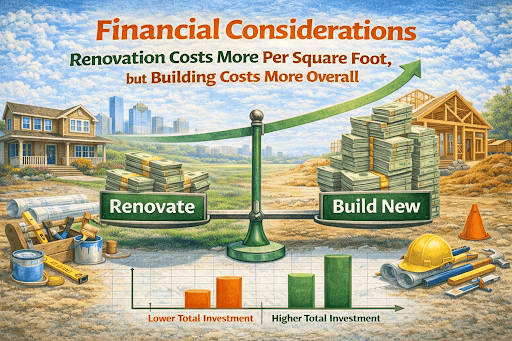
At face value, if you are making your decision on financial considerations only, it is generally more cost-effective to build a new home than to invest in a whole home remodel.
Although with that said, the total amount invested will be a greater total amount in new home construction than in a house renovation. That is to say in simple terms it costs more per square foot to renovate than to build from the ground up, but the renovation will represent a smaller total investment.
Unfortunately, in real terms, your own personal investment situation may not be as simple as calculating a dollar per square foot times the living area.
In some cases, solving your house’s challenges could require renovation and adding a home addition for more living areas. In this strategy, the renovation cost would be a mixture of new home construction and renovation cost elements.
The total amount of a project with major remodeling and a home addition will rival the total cost of building a house.
Cost to Renovate a Home in Houston
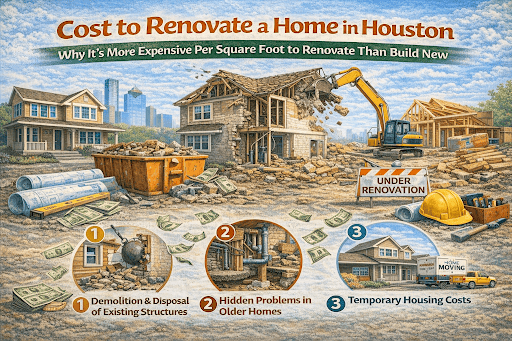
So why is it more expensive per square foot to renovate a home than to build a new one? There are a number of reasons.
First, you must normally be required to demolish existing portions of the house before you can begin to renovate the home.
Secondly, there are always unforeseen items that materialize during a major renovation that was not expected, especially in older Houston homes, many of which were built in the 1960s through 1980s and carry hidden challenges like outdated wiring, galvanized plumbing, or pier-and-beam foundation issues.
Thirdly, there are the non-construction factors associated with renovating the house, like storing your belongings and the need for temporary housing if you are living in the dwelling.
These are costs associated with maintaining two households (mortgage payments, insurance, property taxes) and the additional cost of living outside the house during renovation.
Gathering these anticipated renovation cost estimates can be a bit tricky without construction documents. In the event you do not have access to a general contractor, you will need to develop this cost through estimating.
Depending on your product finish schedule, the owner will need to either develop this estimated cost by using a dollar per square foot or by simply establishing a target investment budget.
The primary factor for a higher dollar-per-square-foot cost of renovation often has to do with the size and scope of the project. For instance, a kitchen may only represent several hundred square feet, but the construction cost of a kitchen represents nearly triple the cost of building a house.
This is also the case of remodeling a bathroom. Both areas of the house carry the most expensive finishes per square foot.
Renovation ROI and Property Value Increase in Houston
One of the most compelling reasons Houston homeowners choose to renovate a home rather than build new is the return on investment (ROI). When you strategically renovate a home, the property value increase can be substantial, particularly in high-demand Houston neighborhoods like the Heights, Montrose, River Oaks, and West University.

Houston-Specific ROI Considerations:
- Kitchen renovations in Houston typically return 60–80% of the project cost in added home value, depending on neighborhood comps.
- Bathroom remodels consistently rank among the highest-ROI renovation projects in the Houston metro.
- Adding square footage through a home addition in an inner-loop Houston neighborhood often yields dollar-for-dollar or better returns, given the premium buyers place on location.
- Energy efficiency upgrades insulation, windows, HVAC, carry particular weight in Houston’s extreme climate and can significantly reduce carrying costs while raising appraised value.
Understanding your renovation ROI requires comparing your post-renovation home value to neighborhood comparable sales (comps). Your general contractor and a local real estate professional should work together to help you model this before committing to a scope of work.
Preservation of Home Equity

One of the most important attributes but often the least considered factor is the preservation of the owner’s house equity. If the owner has been living in their house for 10 years or more, they have normally accumulated both owners’ equity and value appreciation in the property.
When they sell that property to acquire a replacement house property, they are transferring their equity away. They are in effect forfeiting their accumulated appreciation equity in their current property for the new property.
When an owner renovates a home, they are reinvesting in its future value but preserving both their financial equity if mortgaged and the value appreciation that the property sustained in the previous years.
The actual amount depends on the location of the property. Urban area properties typically grow in value at a faster pace than rural properties. In Houston specifically, inner-loop zip codes, such as 77006, 77007, 77019, and 77098, have historically appreciated at rates that significantly outpace the Houston metro average, making equity preservation an especially powerful argument for renovation in these areas.
Building Permits and the Renovation Process in Houston
Any meaningful decision to renovate a home in Houston must account for the renovation process and the building permits required by the City of Houston and, in some cases, surrounding municipalities like Bellaire, West University Place, or Hunters Creek Village.
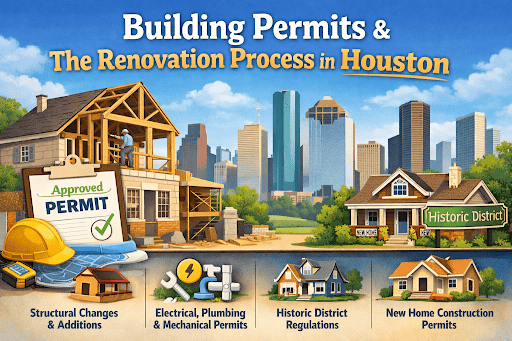
Key permit considerations when you renovate a home in Houston:
- Structural changes moving load-bearing walls, modifying the foundation, or adding square footage, require permits from the City of Houston’s Department of Neighborhoods.
- Electrical, plumbing, and mechanical work must be permitted and inspected, regardless of scope.
- Historic districts such as the Houston Heights or Woodland Heights impose additional design review requirements that can affect your renovation scope and timeline.
- New custom home construction requires a separate set of permits, including a foundation permit, framing inspection, and a certificate of occupancy before the home can be occupied.
Working with an experienced design-build contractor in Houston ensures that all permitting is handled correctly, protecting your investment and avoiding costly stop-work orders.
The renovation process typically follows this sequence: design and planning → permit application → demolition → structural work → mechanical/electrical/plumbing rough-in → inspections → finish work → final inspection.
Cost of New Custom Home Construction
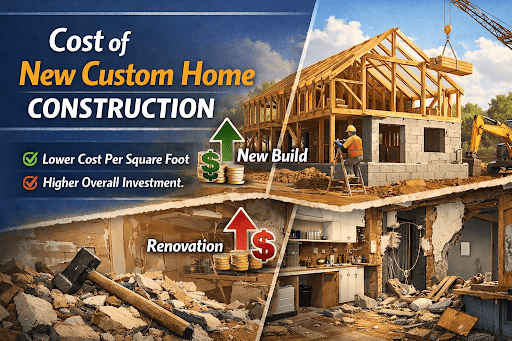
As mentioned, the price per square foot of new custom home construction can normally be less than it would be to renovate a home. Although the total cost of new home construction for a similar house renovation in most cases will be a far greater total investment.
That is to say that for an equal square footage of new construction compared to renovation square footage, the new home construction will be less expensive per square foot for the identical space.
This is generally due to the ability to spread direct and indirect costs over a larger square footage area. These custom home construction costs are averaged out over high-cost areas like kitchens and bathrooms against bedrooms and general living areas.
The main additional cost in new house construction is the structure itself, namely the foundation and frame structure.
Although you may be required in some cases to modify the frame and foundation structure in a renovation project, in very few situations will you have the need to replace the existing structure entirely.
Land Equity in Houston

If you are fortunate enough to have an older property in a Houston metro area that is highly sought after for land value, then giving serious consideration to tearing your older house down and building from the ground up can be a financially beneficial prospect.
The land value of Houston’s inner-loop neighborhoods grows at a faster rate than the actual construction cost composite annually. The construction cost composite indexes consist of a bundle of materials and labor costs similar to stock indexes. Some prices rise while others fall.
Land is a nonperishable item that is in short supply in most of Houston’s desirable neighborhoods. The price of this short-supply commodity continues to increase over the long run much faster than the cost of the building itself.
If you have a vintage Houston house in severe need of renovation or closely approaching structural failure, you should compare neighborhood comps to understand the immediate land values before committing to a renovation budget.
Other than the financial concerns of building a new custom home, there are other matters to consider. Some of these items are advantages, while others may be a disadvantage depending on your personal situation.
The custom home building lot location is often a very high priority for Houston families with children in school districts like HISD, Spring Branch ISD, or Katy ISD, as well as those with strong ties to their community.
If you live in a Houston neighborhood in transition, with a mixture of homes being renovated and tear-down properties, your property is likely a good candidate for new custom home construction.
Architectural Design Flexibility: Structural Upgrades vs. Minor Improvements
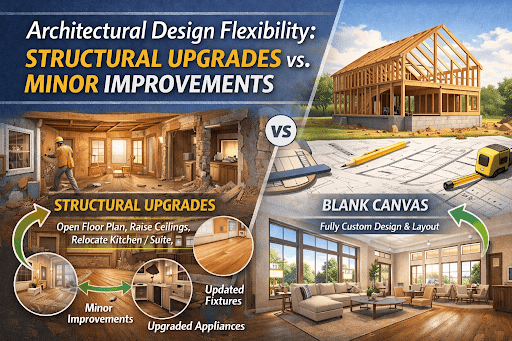
One of the most significant factors in deciding whether to renovate a home or build new is the degree of architectural design freedom available to you.
When you renovate a home, the existing structure defines the boundary of your design possibilities. Minor improvements, new flooring, updated fixtures, fresh paint, upgraded appliances, can be accomplished within the existing footprint with minimal disruption. Structural upgrades, however, such as opening a floor plan, raising ceiling heights, or relocating the kitchen or primary suite, require more invasive work and can approach the cost of new construction on a per-square-foot basis.
When you build a new custom home, you start with a blank canvas. Every room, ceiling height, window placement, and systems layout is designed specifically for your lifestyle. Houston’s luxury home builders at Marwood Construction offer a fully custom design-build process that guides clients from initial concept through final occupancy.
The right answer depends on how far your existing home’s structure will allow your vision to go, and at what cost.
Renovation vs. New Construction: Side-by-Side Comparison
The table below summarizes the key decision factors for Houston homeowners weighing whether to renovate a home or build new.
| Factor | Renovate a Home | New Custom Home Construction |
|---|---|---|
| Cost Per Square Foot | Higher (due to demolition, unknowns) | Lower (costs spread over full footprint) |
| Total Investment | Lower overall | Significantly higher overall |
| Construction Timeline | 3–9 months (typical scope) | 12–18+ months |
| Design Flexibility | Limited by existing structure | Fully custom from ground up |
| Equity Preservation | Preserves existing equity & appreciation | Forfeits current equity on sale |
| Energy Efficiency | Improvable but constrained by existing systems | Modern, fully code-compliant systems |
| Permit Complexity | Moderate (scope-dependent) | Comprehensive (full permit set required) |
| Property Taxes (Houston) | Modest increase based on improvements | Significant increase on full assessed value |
| Disruption to Family | Temporary relocation often required | Must secure housing for full build period |
| Houston Land Value Play | Retains land appreciation in place | Maximizes land value with new structure |

Construction Timeline Comparison
Understanding the construction timeline is critical for Houston homeowners, particularly those coordinating moves around school calendars or lease expirations.
| Project Type | Typical Timeline in Houston |
|---|---|
| Minor renovation (cosmetic only) | 6–12 weeks |
| Kitchen or bathroom remodel | 8–16 weeks |
| Major whole-home renovation | 4–9 months |
| Whole-home renovation + addition | 8–14 months |
| New custom home construction | 12–18+ months |
New home construction timelines in Houston are also subject to delays from permitting, weather (hurricane season), and subcontractor availability. Renovation timelines, while generally shorter, can extend when unforeseen structural or systems issues are uncovered during demolition.
Construction of New Custom House Pros & Cons
Construction of a new custom house is a lofty goal for most people, but if you have the resources and fortitude, building a new house is a once-in-a-lifetime event. There is a sense of accomplishment for the owner when they design and build a one-of-a-kind house.

Advantages
- The custom house can be designed specifically for your every need. When renovating there are often restrictive conditions of the existing structure.
- Building a new house reduces the cost and hassle of ongoing maintenance with an aging house. Everything will be new and have a warranty.
- Building a new residence is going to be much more energy efficient in the consumption of energy sources.
Disadvantages
- A far greater total investment amount than to renovate a home.
- The construction time for new home construction is often twice as long as renovation.
- The property taxes will be significantly more.
Renovate a Home Pros & Cons
Non-financial factors that would lead a house owner to want to renovate a home instead of building a new custom house would be an architectural style that is renovation-friendly.
Another factor would be that the house has been well-maintained and is not in need of major structural repairs.
Advantages
- A house renovation provides the owner with most of the advantages of a newly constructed house at a lesser total cost.
- The renovation construction time is generally far less than the timeline for building a house.
Disadvantages
- If the owner has not done a thorough job of planning to incorporate products and materials that have reached their service life, continued house improvements are likely to continue.
- It can be very inconvenient to have your family be required to move out of your house during renovation construction.
Deciding if you should renovate a home or build a new house requires a disciplined approach of carefully measuring the pros and cons of each option.
The owner conducting their research will set the table for the assistance of a real estate professional or professional general contractor. Consulting a qualified remodeling contractor as a trusted advisor will contribute greatly to your final assessment.
Renovate a Home: Improvements to Consider in Houston
If you decide that renovating a home is the right path, Houston homeowners have a broad range of improvements to consider, from cosmetic updates to comprehensive structural upgrades. The improvements you prioritize should be guided by your renovation ROI goals, your family’s functional needs, and the condition of your existing systems.

High-Impact Improvements When You Renovate a Home:
- Kitchen renovation : the single highest-ROI home renovation in most Houston neighborhoods. Updating layout, cabinetry, countertops, and appliances can transform daily livability and market value simultaneously.
- Bathroom remodeling : luxury bathroom renovations add both comfort and significant appraised value, particularly primary suite bathrooms.
- Home additions : adding square footage is often more cost-effective than relocating in Houston’s competitive real estate market, particularly in established neighborhoods where lot prices are at a premium.
- Whole-home mechanical systems : replacing HVAC, plumbing, and electrical systems in older Houston homes eliminates deferred maintenance and improves energy efficiency for Houston’s demanding climate.
- Whole home remodel : for homeowners whose homes require comprehensive updating, a coordinated whole-home renovation can deliver new-construction quality within the existing structure and location.
- Historical restoration : Houston’s historic neighborhoods such as the Heights, Woodland Heights, and Midtown contain architecturally significant homes that benefit from sensitive restoration rather than teardown.
The improvements you select should always be evaluated against your budget, your timeline, and a realistic assessment of your post-renovation home value relative to neighborhood comps.
Take the Next Step: Make an Informed Decision
Choosing between a house renovation and building a new house is difficult to completely assess without the facts. This requires having the estimated cost for renovation and new home construction to determine which is the best option from a financial feasibility perspective.
With a carefully prepared financial feasibility analysis, the owner can create confidence in which of these two strategies will be the best fit for their needs.
In some cases when the decision isn’t pending on the financial aspects, the owner can simply work through personal matters to make the determination.
Although this is not normally the case, having a clear financial feasibility picture can be the determining factor.
Marwood Construction has guided Houston homeowners through this exact decision for over 45 years. Whether you ultimately choose to renovate a home or build a new custom house, our team provides the construction expertise and trusted advisor relationship to make your investment successful. Contact us today to schedule a consultation.
FAQ
1. Is it cheaper to renovate a home or build a new home in Houston?
Generally, it costs more per square foot to renovate a home than to build a new one. However, the total investment for new home construction is usually higher when considering the overall costs. In Houston’s inner-loop neighborhoods, where land values are high, renovation often delivers the best combination of ROI and preserved equity.
2. Can I preserve my home equity by renovating?
Yes. When you renovate, you retain the equity you’ve built in the home. Renovating allows you to preserve the appreciation in property value, whereas building a new home may result in the loss of your current equity when you sell your existing property.
3. How long does it take to build a new custom home in Houston?
The construction time for a new custom home is typically longer than a renovation, often taking about twice as long, generally 12 to 18 months or more depending on the complexity of the project.
4. What building permits are required to renovate a home in Houston?
Permits depend on the scope of work. Structural changes, additions, and mechanical/electrical/plumbing work all require permits from the City of Houston. Historic district properties have additional review requirements. A qualified general contractor handles permitting on your behalf.
5. What are the best improvements to consider when renovating a home in Houston?
Kitchen renovations, bathroom remodels, home additions, mechanical system replacements, and whole-home remodels consistently deliver the highest ROI for Houston homeowners. The right improvements depend on your home’s current condition, your neighborhood comps, and your budget.