

Construction companies are professional builders that plan, coordinate and build any residential or commercial construction project with their managers, employed workforce and certified subcontractors.
Construction companies are a better choice for property owners than a small contractor when the property owner needs a team to interact with rather than an individual throughout the entire duration of the building project, from initial sketches to the final inspection.
Houston’s construction industry has many construction companies, from small remodeling firms to large construction companies, and every company focuses on its own segment of work.
This guide explains construction companies’ operations, compares their work to that of a separately hired general contractor and describes what types of construction companies can be found in Houston as well as what should be taken into account when signing a contract.
Key Takeaways
The definition of a construction company involves complex project management systems. A construction company cannot just be reduced to a worker doing one or several types of construction jobs.
Generally, full-service companies combine in-house trade competencies with various project skills. Houston construction companies can be classified as residential, commercial, design-build and renovation firms. The experience related to local legislation has more value than a recognisable name.
Did You Know?
There were about 12,100 new construction jobs created in the Houston area during one year ending in May 2026, as reported by the Federal Reserve Bank of Dallas and the Bureau of Labour Statistics. This is one of the most prominent growths for the construction sector.
What is a construction company?
Construction companies carry out many different services, such as excavation, concreting, and framing. More generally speaking, a construction company takes care of coordinating the three important factors in the construction process — labour, money, and time. It helps to make sure that everything goes according to the plan, from brainstorming to implementing the project, without requiring too much effort from the owner.
Most construction companies handle:
- Before construction takes place, it is necessary to create designs, establish budgets, and request permits.
- It is also important to hire engineers, designers, and planners and supervise their work.
- Setting a working plan and overseeing subcontractors and other professionals
- Purchasing and quality assessment of the materials to be used
- Ensuring safety and compliance with codes
So what does a construction company do differently from a lone tradesperson? It carries administrative and legal responsibility for the entire scope of work, not just one trade. That single point of accountability is the main reason property owners hire a company instead of assembling their own crew of specialty contractors.
Construction Companies vs. General Contractor vs. Specialty Contractor

Houston property owners often confuse construction companies with general contractors or specialty contractors. Although these words have similar meanings, there is a crucial difference between a construction firm and a general contractor.
The main distinction lies in the structure and scale of work performed. A general contractor may have only one licence to oversee the project, whereas a construction corporation usually is a company with many employees, tradesmen, resources, and staff.
| Feature | Construction Company | Individual General Contractor | Speciality Contractor |
|---|---|---|---|
| Business structure | Established firm with staff & systems | Often a sole proprietor or small team | Licensed single-trade business |
| Typical scope | Full project, design through completion | Full project, coordinates subs | One trade or product replacement |
| In-house trades | Often yes. | Rarely | Yes, within its own trade |
| Design-build capability | Common | Occasional | Not offered |
| Best fit for | Whole-home builds, remodels, buildouts | Small to mid-size single projects | Roofing, HVAC, windows, painting |
An in-house trades construction company model works well for owners who want one accountable team instead of managing multiple vendor contracts themselves. For a full breakdown of the general contractor’s specific duties and licensing, see our dedicated general contractor’s role guide; this page focuses on which category of company fits your project in the first place.
Different Types of Construction Companies

Not every construction company serves the same market. Knowing the kinds of construction firms in Houston allows you to choose the most suitable one before seeking bids.
Construction companies can be classified into four main types: residential, commercial, design-build, and renovation companies. Some companies, for instance, provide construction services in more than one of these categories at the same time.
| Type | Typical Projects | Who It Serves |
|---|---|---|
| Residential construction company | New homes, additions, whole-home remodels | Homeowners |
| Commercial construction company | Office buildouts, retail, warehouses | Business & property owners |
| Design-build construction company | Projects needing architecture + construction in one contract | Homeowners & businesses |
| Remodeling/home improvement company | Kitchens, bathrooms, roofing, windows | Homeowners & light commercial |
Building Companies in the Residential Sector
Building companies that specialise in residential construction are often hired by homeowners in Houston to work on projects related to single-family homes and townhouses, as well as home extensions and renovations.
The main difference between residential builders and their commercial counterparts is in the scale of their projects and the building codes involved. Residential building projects are usually not covered under codes applicable to multi-family and assembly-occupancy types of buildings.
When comparing a residential construction company, a Houston-based firm, against an out-of-state brand, local code knowledge and established trade relationships usually matter more than name. recognition. Homeowners planning a ground-up build can find more details on our custom home builders and home builders pages.
Business Construction Businesses
Business construction businesses cater to the construction of office buildings, shopping centres, warehouses, and similar commercial infrastructures, and they usually use either steel or concrete to carry out the work. As commercial construction involves its own regulations, we provide a separate section for resources on commercial construction companies and builders.
Design and Build Construction Companies
Design and build construction businesses essentially provide buyers with integrated project delivery since they provide design and project development services all under a single amenable contract. We walk through how that process works step by step on our design-build construction page.
Remodeling and Home Improvement Companies
Remodeling companies and home improvement contractors handle everything from kitchen and bathroom renovations to roofing, window, and door replacement. Some are licensed single-trade specialists, often called product replacement contractors, while others are full remodeling contractors managing multi-room projects from start to finish.
What Are Full-Service Construction Companies?
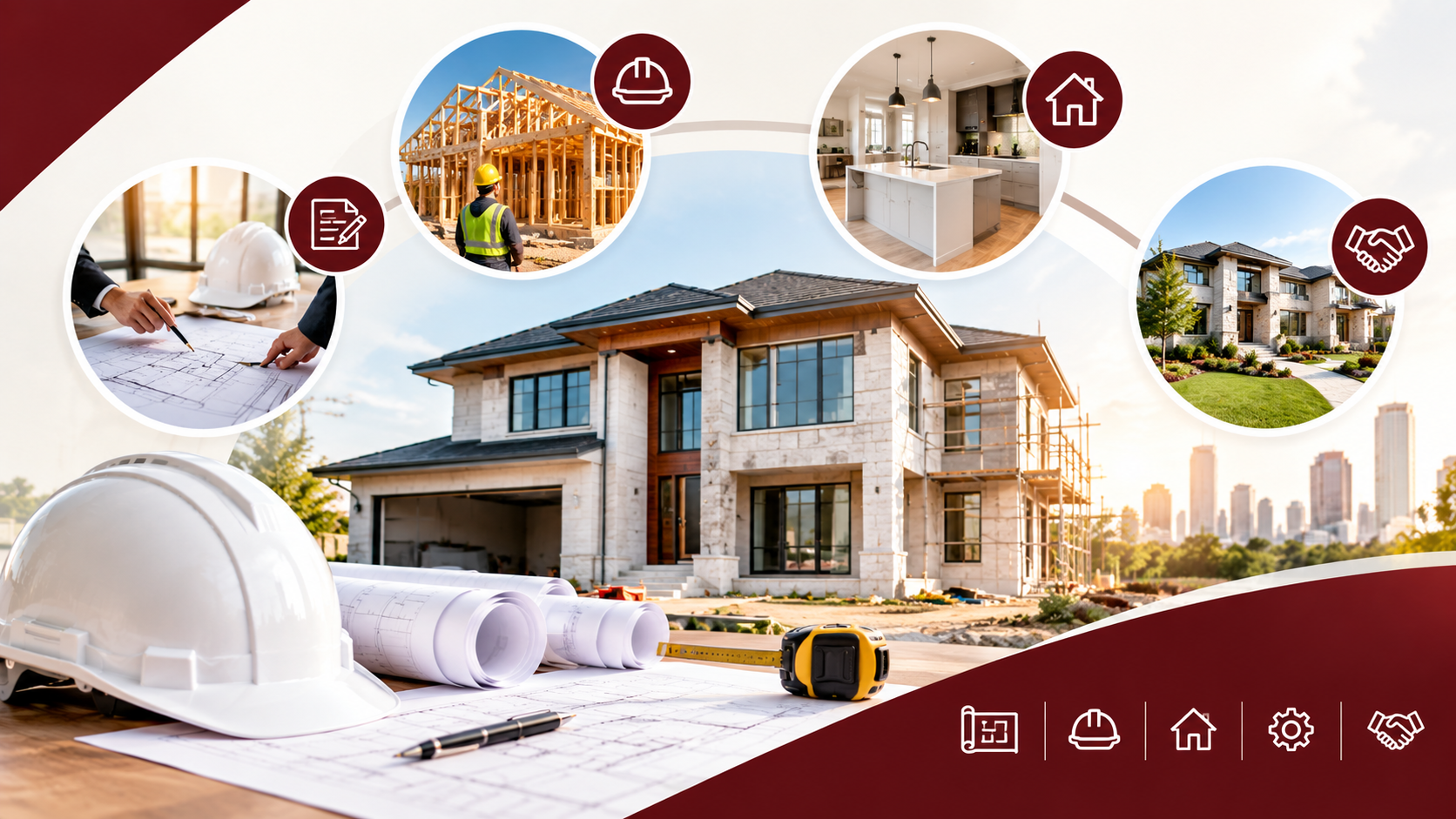
A full-service construction company is built around three capabilities that a single tradesperson or narrow-specialty firm typically cannot offer on its own.
1. Design-build Possibility
All-encompassing companies can supervise architecture design, study, and construction processes themselves, which makes the time between the design stage of the project and construction shorter.
2. Internal specialists
Using company employees in roles such as carpentry and project management instead of looking for outside specialists can help business owners better organise the process on-site.
3. Project Scope Range
Full-service companies can move between a single bathroom remodel and a ground-up custom home without changing firms because their construction company capabilities scale with the project.
These construction company capabilities, design-build service, in-house trades, and a wide project scope are what separate a full-service firm from a speciality contractor that only performs one type of work.
Planning & Operational Services of Construction Companies
Pre-Construction & Planning
- Feasibility studies and land surveying: Evaluation of a site’s viability involves determining soil composition, soil condition, and site boundaries. Before any design commences, construction companies first determine whether the selected site can support the construction project. This involves conducting soil tests on the site for load-bearing capacity and drainage, performing topographic surveys to understand elevation and performing boundary surveys to establish legal limits of the property. In this stage, the findings will inform decisions made later on, as this information determines the design requirements of the foundation and drainage system and whether the project can be feasible at this particular site.
- Architectural and engineering design: This is the process of producing drawings, structural projects, and compliance measures according to building codes. It transforms the idea of the client into building documents like floor plans, structural schemes, and MEP schemes. Engineering specialists check that the design is compliant with local building regulations, conditions of wind and seismic activity, and energy regulations.
- Permitting and zoning: Obtaining appropriate legal authorisation from the relevant local governments. All locales require permission prior to breaking ground; this includes building permits and zoning changes, and sometimes environmental and floodplain approvals as well. Because different counties and cities have different permitting processes, and errors in the permitting process can cause significant delays in construction, most construction companies perform this task for their clients.
Management & Contracting
- General contracting: As the party responsible for the day-to-day management of the site, the general contractor is tasked with the management of term delivery and the organisation of the site’s labour resources, such as specialised tradesmen, work scheduling, material ordering, and monitoring of logistics. They also take the blame in case of a failure.
- Construction management: The company takes on the responsibility of acting as the owner’s representative in managing budgets, deadlines, quality, and safety issues at the site. In this scenario, the company works as the owner’s representative instead of the builder and supervises budgeting, timelines, quality assurance, and safety regulations across many contractors. This approach is mainly implemented in large projects or complex operations, where the owner wants an unbiased assessment rather than a contractor who can do both job management and reporting.
- Design-build: To unite the design and construction stages of a project under one contractor. Rather than separately contracting a designer and a builder, the design-build system combines both stages into a single agreement under one responsibility. This often results in faster timeframes, as construction planning can begin prior to the finalisation of the design, and fewer conflicts arise between the designer and builder.
Execution & Specialised Trades
- Site development: Preparing the site may involve generating access roads, preparing soil, and building foundations. Before any vertical construction can begin, all kinds of preparatory work should be done, from clearing the land of vegetation and rubbish to properly grading the land to ensure correct drainage and excavating for foundations, utilities, and possibly basements. Inadequate site preparation is one of the most frequent reasons for later drainage problems and structural failures.
- Structural and civil work: Installing foundations means pouring concrete, as in forcing steel frames in place for heavy infrastructure such as roads and bridges, in order to make possible the construction of a load-bearing framework in the course of pouring concrete footing and slabs. All of this has to be done with great precision of engineering since the reliability of everything else built on top of it depends on its great accuracy and precision.
- MEP systems: Installation of the mechanical, electrical, and plumbing systems. Contracted specialty subcontractors are responsible for installing the mechanical, electrical, and plumbing systems; the general contractor oversees this work. This process involves the installation of HVAC ductwork, electrical systems and panelling, in addition to plumbing systems and waste lines which must undergo rigorous inspections before they can be hidden.
- Finishing trades: This stage involves finishing drywall work, implementing interior and exterior paint applications, flooring installation, roofing, and window/door installation. The process is what makes the project seem nearly finished, even when it is usually one of the last phases before handing over the completed project.
Post-Construction & Maintenance
- Commissioning and handover: Concluding inspections, cleaning, and client walk-through. Before a client takes possession, the project must undergo final inspections to ensure compliance with the necessary regulations, proper cleaning, and a walk-through where any punch-list items are dealt with.
- Facility management: Continuous maintenance of the building, HVAC maintenance, and security surveillance. Some construction companies, especially large companies that specialise in commercial projects, continue with building maintenance even after the project handover, such as HVAC maintenance, security system monitoring, and honouring the warranty for the completed job by the contractors.
- Renovation and remodeling: Improving, fixing, or increasing existing buildings. In addition to new buildings, many contractors work on improving existing buildings, which could be anything from the renovation of a single room to the construction of a new wing. This work often carries its own complexity since it has to integrate with an existing structure’s systems and code status.
Construction Companies Execution Services for Construction Management
Construction Company Services
- General Contracting: Supervising short-run operations at construction sites. General contractors carry out work on a construction site, which involves tasks such as employing workers, managing a budget, implementing schedules, and so on.
- Design-Build: Integrating design and construction operations into one cooperative framework. In this delivery method, the design and construction responsibilities are integrated into a single agreement, making only one working team responsible for the whole construction process instead of assigning a designer and a builder.
- Pre-Construction Planning: Performing feasibility studies, calculating costs, and scheduling are part of the groundwork. The company performs feasibility studies, calculates costs, and creates a realistic schedule for its projects so that the customer has a good idea of what to expect beforehand.
- Site Development: Clearing, grading, excavating, and setting up utilities. This covers clearing, grading, and excavating the site, along with setting up the utilities the project will need once construction is underway.
- Renovation and Remodeling: Updating or altering existing interior and exterior layouts. For existing properties, this means updating or altering interior and exterior layouts, whether that is a single room or a full-property overhaul.
Benefits of Hiring Construction Companies
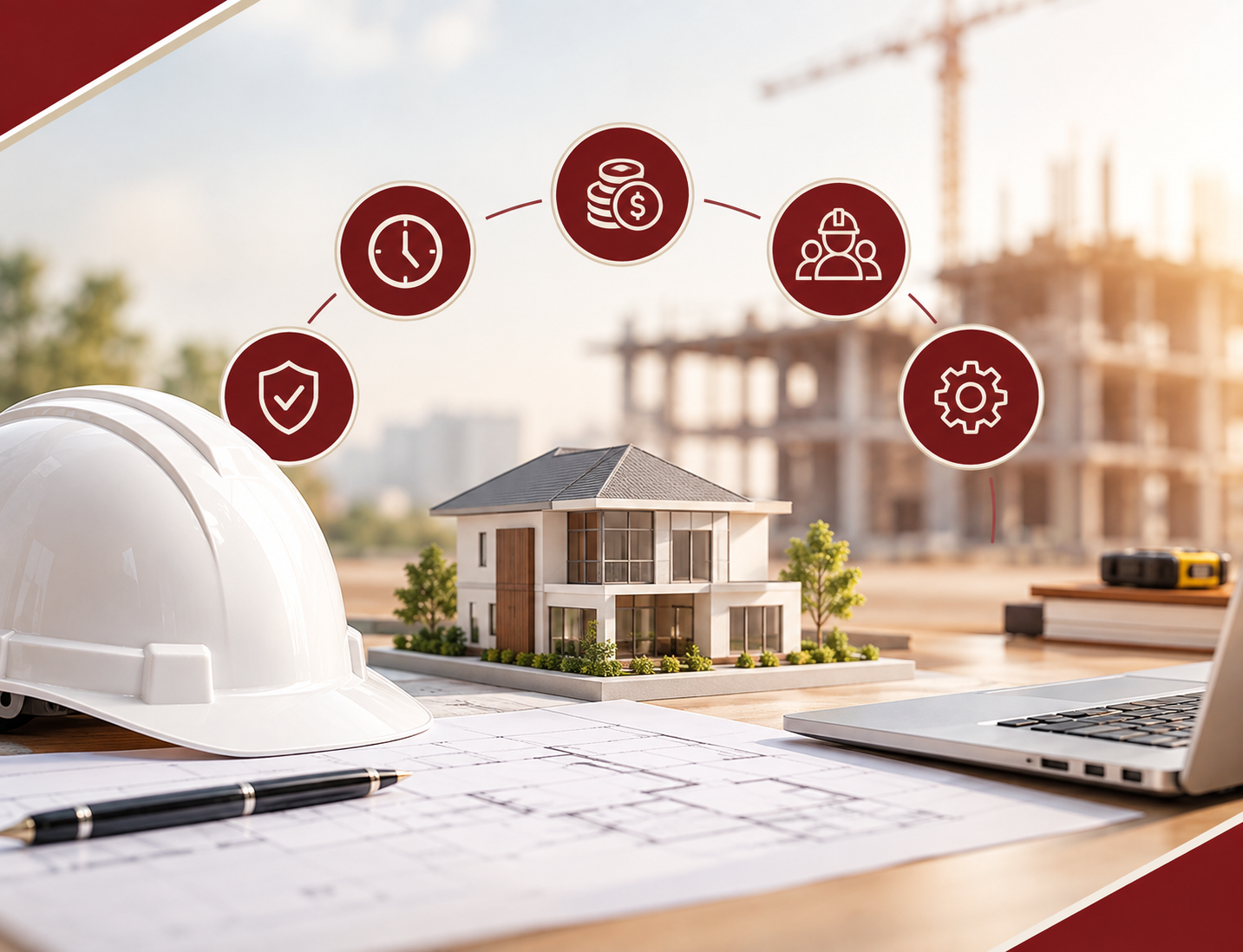
- Single Point of Contact: You communicate with one project manager instead of chasing down dozens of separate workers, electricians, and plumbers. Rather than managing separate relationships with an electrician, plumber, framer, and roofer, the client deals with one project manager who is accountable for the whole job.
- Expertise & Experience: Construction company management is seasoned experts in the field of construction operations, codes, contracts and risk mitigation. One of the important benefits that an owner is paying for is the learning curve of previous lessons that come with experience.
- Cost and Budget Control: Companies use precise estimates and supplier connections to buy materials more cheaply and stop surprise expenses. Established companies have existing supplier relationships and buy materials in volume, often securing better pricing than an individual coordinating trades themselves, and their estimating experience helps avoid budget surprises mid-project.
- Time Savings: Experienced crews follow strict schedules and fix delays quickly so your project finishes on time. Crews who work together regularly follow tighter schedules, and an experienced company is faster at diagnosing and resolving delays such as permit holdups, material shortages, or weather than someone managing a project for the first time.
- Legal and Code Compliance: Professionals know local zoning laws, building codes, and safety rules, which keep you out of legal trouble. Professionals stay current on local zoning laws and building codes, which reduces the risk of failed inspections, stop-work orders, or legal exposure from non-compliant work.
- High Quality and Safety: Licensed teams use specialised tools and proper techniques to build durable structures while protecting you from injury liability. Licensed crews bring proper tools, training, and safety protocols, lowering both the risk of injury on site and the risk of substandard workmanship that shows up later.
- Reduced Stress and Peace of Mind: Managing logistics yourself is hard work; a full-service team handles the day-to-day problems for you. Coordinating a construction project involves permits, scheduling, inspections, and vendor issues; a full-service team absorbs that workload so the owner does not have to manage it directly.
Choosing Construction Companies in Houston
In selecting a construction firm for a job, the first step is to ensure that the type of firm matches the type of project.
You should ask yourself three questions before you start requesting proposals.
- For this type of work, do I need a residential contractor, a commercial contractor, or a specialty contractor?
- Does the company provide design-build services, or do I need to hire an architect myself?
- Are the tradespeople involved doing the work in-house, or does the company use subcontractors?
For a deeper, criteria-by-criteria checklist on vetting a specific residential builder, our home construction company guide walks through the evaluation steps in detail. This page is meant to help you decide which category of company to approach first.
Construction Companies Near Houston: Local Service Considerations

When homeowners want to check construction companies that are in close proximity to Houston, there are things they must consider, such as the origin of clay soil, threats of hurricanes, and research on permitting issues pertaining to flooding. Knowing the meaning and functions of Harris County and City of Houston permitting offices will help such homeowners begin a project in a cost-effective manner.
Marwood Construction has specialised in serving residents of Houston and surrounding areas, namely River Oaks, Memorial, Bellaire, Museum District, Tanglewood, and Sugar Land for over forty years. A full list of the neighbourhoods and zip codes we serve is available on our service areas in Houston page.
Expert Insight
“Homeowners often assume ‘contractor’ and ‘construction company’ mean the same thing, but the difference shows up the moment something outside the original scope comes up. A company with in-house trades and its own project managers can absorb that change without stalling the schedule.” — Patrick Martin, CEO, Marwood Construction
Conclusion
Learning the definition of a construction company and how it is different from a general contractor or a trade contractor is the first step to hiring the correct team for the Houston project you have in mind.
Regardless of whether you are looking for a company specialised in home renovations or a full-service one that performs works of a different nature and scope, it is crucial to find a company that is appropriate to your project goals and objectives in order to save time, money, and nerves.
Contact us at Marwood Construction to talk about your project with a construction company in Houston, or check the projects we have undertaken.
Frequently Asked Questions
Q1: What distinguishes a construction company from a general contractor?
Ans: A construction company is typically a well-established organisation with a team of employees, equipment, and systems as opposed to a general contractor, who may be one individual holding a permit and operating in this capacity. Many construction firms will hire or involve general contractors as one of the elements of project management.
Q2: What is the main function of construction companies that cannot be performed by specialty contractors?
Ans: A construction firm heads the entire project, starting from design management and scheduling to coordination of various trades, while specialty contractors usually execute a certain kind of work (e.g., roofing, electrical).
Q3: Are Texas general contractors obliged to get a licence?
Ans: No. Texas does not require the presence of a general contractor’s licence, yet many companies engage in obtaining local certifications, bonding, and insurance to display professionalism to clients.
Q4: What qualities should I search for in a general contractor?
Ans: Make sure that it has a design-build division, tradespeople working under one roof, a variety of hand-on experiences with construction projects in Houston, and a clear list of types of projects it works on.
Q5: How can I tell if I need a residential or commercial contractor?
Ans: Any addition and any type of single-family home is part of the residential sector, while commercial constructions will include buildings such as offices, malls, and apartment complexes; all of them will have their own construction codes.
Q6: How can I narrow down my options when choosing the right construction company?
Ans: Start with determining the type of project and only then reach out to two or three companies that deal with such projects and compare their experience with similar projects.