

A commercial construction project requires the experience and skills of commercial general contractors that fit the owners’ and project needs for the best results. There are many types and sizes of projects, having a host of challenges and needs, which individual business owners may find far more difficult to negotiate.
The types of commercial construction projects may include smaller office buildings, strip centres, retail shops, banks, hotels and restaurants, and others. They also include smaller multifamily buildings, repurposing existing space or just redeveloping existing property.
The construction management of commercial properties is a comprehensive process involving scores of players or stakeholders, and a single entity or individual overseeing them is known as the commercial general contractor or prime contractor.

Key Takeaways
- General contractors manage all parts of the contractor implementation process from the initial start-up stage to the completion stage.
- The knowledge of contractors makes it possible for companies to keep the deadlines and refrain from overspending because of efficient scheduling and management.
- By employing a proficient contractor, enterprises lower the risks of supply chain disruptions, defects in the design, and other issues.
- Thus, contractors are significant when it comes to finance, process planning, safety measures, and communication.
Did You Know?: “It is possible to save up to 15% on costs through proper scheduling, procurement planning and contractor coordination when managing any commercial construction project.”
The hiring of commercial general contractors to oversee the commercial construction of any relevant construction project is important to navigate the process, address any unforeseen issues, communicate with the project owner(s), and meet the project deadlines.
The unforeseen bottlenecks or obstacles can derail any such project unless the commercial construction companies have the expertise and experience to see it through.
It is possible that an individual property owner may hire scores of subcontractors and specialists to work on a construction project for their benefit.
However, the absence of proper construction operation controls and a single point of authority in a general contractor can lead to undesirable results.
There are many adverse incidents that can occur during a project such as work stoppages, design flaws, and supply-side bottlenecks, among others.
So, to ensure the timely completion of a commercial construction project within budget, property owners and investors look to hire experienced commercial general contractors.
Let us understand the functions of commercial general contracting. We will explore the roles and the activities that come with searching for commercial general contractors near me.
Commercial General Contractors: Who Are They?

Commercial general contractors are the licensed companies that take full responsibility for the entire commercial project. Their responsibilities include getting the permits needed for the project and completely finishing the construction.
Such companies are different from trade contractors that focus on carrying out specific tasks and from architectural firms that conduct the design of the project without acting as builders.
Usually, business owners, developers and property managers looking for commercial general contractors near me compare full-service commercial companies with those focused on a particular area. This is how clients can get used to differentiating firms and selecting the proper one for their projects.
If your scope is closer to a tenant build-out or interior fit-out, see commercial construction contractors for that specific angle.
Commercial General Contractors vs. Construction Company: Knowing the Difference
Not every commercial general contractor near me search should end at the same type of firm. The analysis of commercial general contractors and construction firms usually shows that there is only a slight difference between these two types of organisations. In terms of project lifecycle, the factors and approaches are different when it comes to subcontractors and in-house trades. Below is a comparative overview of a commercial GC, a full commercial construction company and a single-trade speciality contractor.
| Attribute | Commercial General Contractors | Specialty Commercial Contractors |
|---|---|---|
| Primary role | Single point of authority over the entire project | Executes one trade scope (electrical, HVAC, etc.) |
| Subcontractor management | Hires, coordinates, and supervises all trades | Reports to the GC or owner directly |
| Typical engagement | Renovations, build-outs, and mid-size commercial builds | One defined scope within a larger project |
| Owner contact | Single contract, single point of accountability | Usually contracted through the GC |
| Best fit for | Owners who want one firm accountable for the whole job | Owners who already have a GC or CM in place |
For a market-specific look at how local firms stack up, see our Houston general contractors comparison, and for background on regional licensing conventions, see Houston contractors.
What are the functions of commercial general contractors?
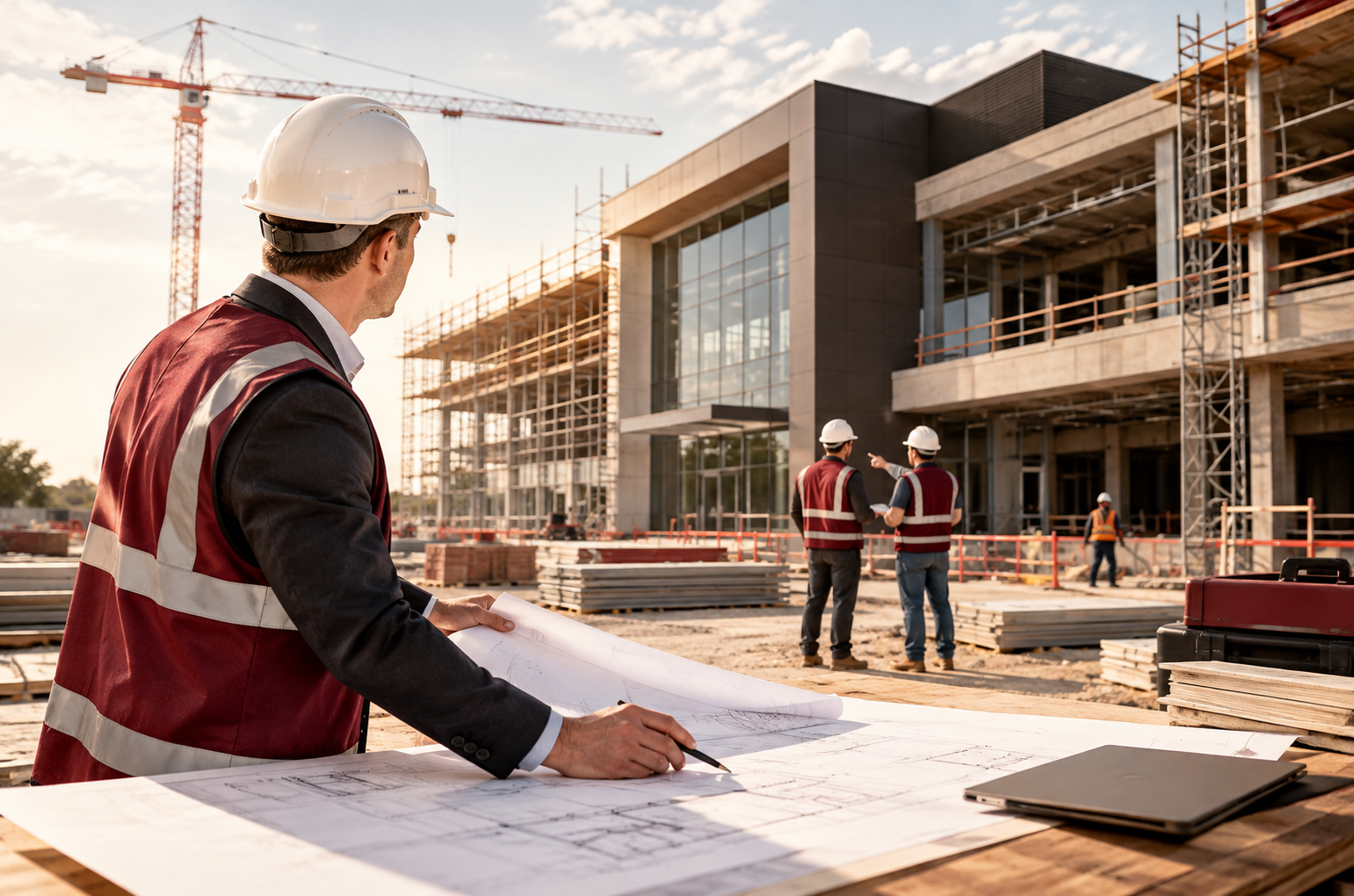
Commercial builders, aka contractors, oversee the development of a commercial construction project right from preconstruction planning to the delivery of the property to the owner.
They are engaged in a host of project management administration activities, such as keeping track of the cost, scheduling the workforce, and coordinating between key stakeholders, including local officials, among others.
For the onsite construction management, they represent the control of all quality control testing, the logistical trafficking of labour, materials, and equipment, as well as contracting and procurement responsibilities.
In fact, the selected commercial general contractors near me can be thought of as the glue that holds the entire project together. You may read details of the role of general contractors in commercial construction.
Workmanship
A commercial general contractor has the expertise and experience in all aspects and areas of a construction project.
In addition to providing labour, materials, and equipment for the project, he or she also offers services in areas such as design, estimation, procurement, financial management, scheduling, and construction management.
Houston commercial contractors coordinate with professionals belonging to multiple trade disciplines and working at the job site to work towards a common goal.
They are accountable to the project owner as far as completing the project within time and budget.
They are also responsible for maintaining quality control with respect to performance specifications throughout the construction process.
Maintaining quality control standards begins with clearly defining the scope of work, requiring trade compliance with the performance specifications, and documenting the desired workmanship standards.
Depending on the size of the project, there can be multiple levels of compliance inspections other than the commercial general contractor near me.
Design
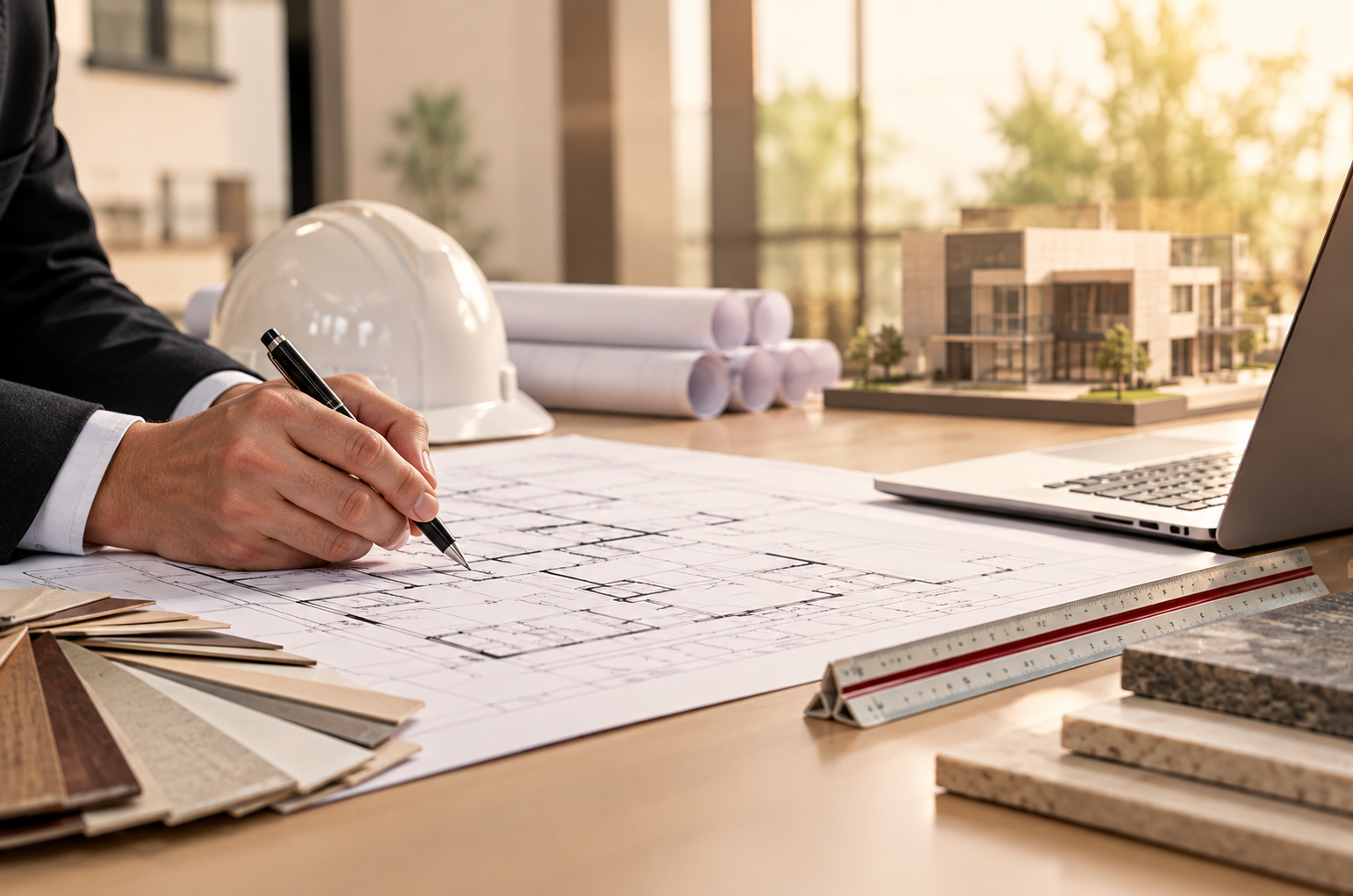
Even though most commercial builders are not involved directly in design work, they may work with designers or architects.
They are involved in offering value engineering solutions for complex designs and finalising products’ specifications to make the construction more cost-effective.
A second valuable role that commercial contractors play in the design phase is evaluating constructability.
Certain untraditional designs can lead to potential construction issues if not identified early in the design process.
And once the specifications and drawings are complete, the building contractors develop material takeoffs using the construction plans to create schedules of values for the estimated cost.
Thereafter comes procuring the materials in quantities that are mentioned in the specifications after comparing and verifying the subcontractors’ bids.
Scheduling pre-construction
This is arguably one of the key services offered by building contractors and entails the planning of labour, logistics, equipment, and materials.
Pre-construction scheduling is used to create various scheduling paths to execute each required task and determine the time needed to complete the entire project.
Scheduling plays a significant role in developing successful execution plans that map out time duration and conflicting events to avoid.
This is also important to know to determine the estimated general conditions, which are jobsite overhead costs (JSO).
JSO includes construction operation costs that occur even if work activity is at a standstill. These project costs are items such as onsite management, rental equipment, and job site security, among others.
Also, pre-construction services may involve reviewing the construction documents, developing the preliminary budget and salient building codes, and developing and analysing the preliminary schedule to identify any potential bottlenecks or sticking points.
A seasoned commercial general contractor will evaluate and plan alternative scheduling paths in anticipation of possible problems.
So, by identifying and eliminating these issues at the early stages, the project has a greater likelihood of a successful outcome and meeting the project goals.
Hassle-free completion of the project

By hiring a commercial general contractor either for new construction or remodeling, the project or property owner does not need to worry about coordinating with various players at the job site and making them work according to a schedule.
The general contractors will be ultimately responsible for getting the project done within the constraints of time and cost, and should there be an escalation, the same shall be discussed with the project owner to arrive at a solution.
It is important to mention that there is a greater opportunity for a project’s success if the architect, engineers, and general contractor function in a collaborative manner instead of a combative manner.
Financial management
Financial management is a crucial service to measure the health of the construction project and involves managing the cash flow and profitability.
It involves establishing the itemised line-item cost for all tasks and is taken as a benchmark to drive cost control throughout the construction process.
By keeping tight control of cash flow, the prime construction company ensures the project progresses without facing any interruptions in the flow of labour and supplies.
Materials
For any remodeling or new construction project, the value of materials and equipment to be used needs to be estimated and procured at the job site.
The materials should meet or comply with all design specification requirements and building codes.
Building contracting is all about the skill of knowing what, how much, and when the subcontractors would need the materials and how to replenish the same when finished.
It is essential that long-lead-item materials be identified early in the planning stage to allow for substitution, when possible, to avoid project delays.
These can occur as a result of logistical shipping, manufacturing, delivery delays or unpredictable foreign tariffs being imposed.
Managing subcontractors

Any commercial construction project (small, medium, or large) needs the participation of multiple trades such as mechanical, electrical, masons, carpenters, and others.
Seeking the right commercial general contractors near me that are capable of managing the subcontractor’s project activities is essential to the progress of the project.
The general contractor manages the administrative requirements that involve subcontractor contracts, insurance, payment processing, and lien releases.
In addition, they manage the on-site construction activities, such as quality control, scheduling, and safety.
The job can be quite exhausting, and the wasteful expenses and leakages can rear their ugly heads unless the general contractor overseeing the project keeps track of everything, including the quality of construction undertaken by the subcontractors.
In the absence of coordination, subcontractors engaged in several projects may disregard one particular project, leading to delays. Many delays may cause a chain reaction that results in very expensive delays.
Liaise with local authorities
Building a non-residential property means complying with the local building codes and arranging the compliance inspections of the property at various stages of construction.
The general contractor needs to liaise with the local authorities and schedule a date for the inspection of the property.
It is only after the property is duly inspected and certified for meeting all building standards that the property can be ultimately handed over to the project owner.
Logistics
Procuring building materials and equipment from suppliers has become technical, with next-gen tracking being utilised.
It is no longer about calling the local area supplier to place an order and wait for the supply of materials at the job site.
Planning the advanced delivery involves understanding where the materials or equipment are coming from and where they will be stored on-site until needed.
It also has to do with how that material will be transferred to the actual building and stored until needed.
In dense urban construction site locations, even construction trade parking can become a major problem for the local properties nearby.
Safety

Safety on commercial construction sites is a big deal to the overall performance and liability of general contracting for both the general contractor and subcontractors.
Accidents, injuries, and deaths are closely monitored on construction sites by OSHA.
There are critical statistics measured that affect both insurance risk rates and the short- and long-term job site operational procedures of high-risk activities.
A spike in these numbers can lead to financial liability risk for all concerned.
Did You Know?: As per the U.S. Bureau of Labor Statistics’ Census of Fatal Occupational Injuries, the number of construction-related deaths decreased from 1,075 in 2023 to 1,034 in 2024; however, construction is still responsible for approximately 1 in 5 deaths that occur in the workplace in the U.S. Therefore, it is advisable to check a commercial general contractor’s safety record and safety programme before signing a contract. Source: bls.gov/news.release/cfoi.htm
Supervision
This is supposedly the backbone of construction management, as the contractor provides on-site directions to the stakeholders to achieve the desired results.
In the absence of proper supervision, the entire project can turn chaotic, leading to disarray and cost escalations.
And for large and complex projects where people of multiple skills and trades are involved, building contractors can drive the project to its logical conclusion.
The above-mentioned functions or the areas of operations of contractors hired for remodeling or new-build contracting to ensure bottlenecks or missteps are avoided, the use of resources is optimised, and the construction process is facilitated with seamless coordination between various players.
Further, you may view our video to know about the job of a contractor in a contracting project.
How to Choose Commercial General Contractors in Houston

Knowing how to choose a commercial GC is different from knowing what one does. Once you understand the role, the next step is to compare specific firms against a consistent set of commercial contractor selection criteria.
The five areas below cover most of what separates a dependable commercial general contractor from a risky hire.
1. Commercial General Contractors’ Credentials
Confirm that any firm on your shortlist carries current commercial general contractor credentials appropriate to the project type and jurisdiction. In Texas, general contractors are not state-licensed, so verifying general contractor licensing and registration details at the city or county level, along with trade-specific licences for electrical and plumbing subcontractors, matters even more.
2. Licensed, Bonded Commercial General Contractors
Ask to see proof of bonding and general liability, workers’ compensation, and builder’s risk coverage before work begins. Licensed bonded commercial contractors protect the owner financially if a subcontractor walks off the job or a claim arises; see our overview of contractor insurance and bonding requirements for what to request.
3. Commercial General Contractors Portfolio
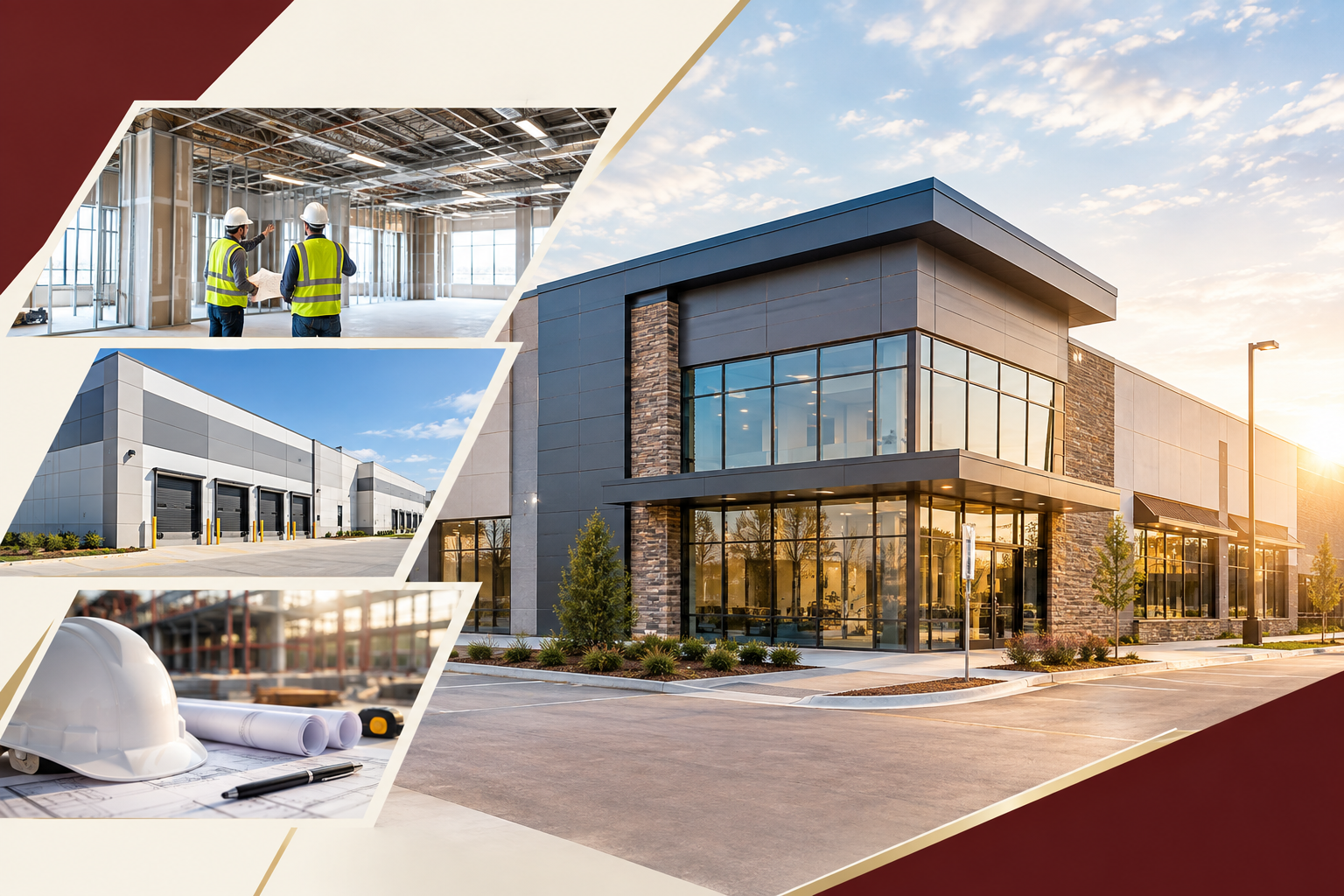
Review the firm’s commercial general contractor portfolio for projects similar in size, building type, and complexity to yours. A commercial project gallery with recent, verifiable work is a stronger signal than a client list alone.
4. Commercial GC Safety Record
A commercial GC safety record should be discussed openly, including OSHA recordable incident rates (EMR) and any citations from the past three years. Firms that can produce this documentation without hesitation are generally the ones managing safety proactively rather than reactively.
5. References and Local Reputation
Speaking directly with two or three recent Houston clients, ideally for projects of comparable scope, tells you more than online reviews alone. Ask former clients specifically about change-order handling, schedule adherence, and communication during problems.
| Selection Criteria | What to Verify | Why It Matters |
|---|---|---|
| Licensing & registration | City/county registration, trade sub-licenses | Confirms legal standing to operate and pull permits |
| Bonding & insurance | Bond amount, GL, workers’ comp, builder’s risk | Protects the owner if a claim or default occurs |
| Project portfolio | Recent, comparable projects with references | Shows real capability, not just marketing claims |
| Safety record | EMR rating, OSHA citations, safety programme | Lower risk of delays, liability, and site incidents |
| Financial stability | Bank/surety references for larger contracts | Reduces risk of mid-project insolvency |
Evaluating Commercial General Contractors in Houston: Questions to Ask
Evaluating commercial contractors Houston-wide gets easier with a short, consistent list of questions for every firm you interview.
- How many active commercial projects is your team currently managing?
- Who is the dedicated superintendent for a project our size, and how often are they on site?
- Can you share your EMR and any OSHA citations from the last three years?
- What does your subcontractor vetting and payment process look like?
- Can we visit a current job site or speak with a client from a similar project?
For a longer list, see our full questions to ask a general contractor guide.
Partner with Houston’s Trusted Commercial General Contractor

To turn the vision of commercial construction into reality, right from the drawing board to final completion, the services of Houston commercial contractors can be hired.
They help the project avoid facing cost overruns and missed deadlines.
They are the go-to people for investors and business owners to either construct a commercial property from the ground up or remodel it according to specifications.
You may read a blog to learn how contractors dealing with commercial remodeling or contracting can be of help.
Top Commercial General Contractors: What Sets Them Apart
Among top commercial general contractors, the differentiators are rarely marketing claims; they show up in the details covered above. A consistent safety record, a portfolio of comparable completed work, and transparent financial reporting tend to separate dependable firms from the rest.
Houston’s commercial market includes everything from single-building retail buildouts to multi-storey mixed-use developments, so the firm that fits your project depends on matching its documented experience to your project’s scope, not on size or advertising reach alone. Our commercial builders overview outlines the range of commercial work Marwood Construction handles across the Houston area.
FAQs on Commercial General Contractors
Q1: What does a commercial general contractor do?
Ans:- A commercial general contractor manages the entire lifecycle of a commercial construction project—from preconstruction planning, budgeting, and scheduling to on-site supervision and final delivery.
Q2: Why should I hire a commercial general contractor?
Ans:- Hiring a commercial general contractor ensures expert project coordination, risk mitigation, adherence to local building codes, and timely completion within budget.
Q3: How do commercial general contractors manage subcontractors?
Ans:- They oversee subcontractor contracts, insurance, and scheduling while maintaining quality control and site safety to ensure seamless collaboration among multiple trades.
Q4: Are commercial general contractors involved in design?
Ans:- Yes, while they don’t design directly, they work closely with architects and engineers to provide value engineering and improve constructability and cost efficiency.
Q5: What makes Houston commercial general contractors stand out?
Ans:- Top Houston contractors like Marwood Construction combine decades of expertise with proven construction management systems to deliver precision-built commercial spaces.
Q6: What licence does a commercial general contractor need in Texas?
Ans:-Texas does not require a statewide general contractor licence, so verification instead focuses on city/county registration, trade-specific sub-licenses, and bonding. See our Texas contractor licensing guide for specifics.
Q7: How is a commercial general contractor different from a commercial construction company?
Ans:- A commercial general contractor typically manages renovations and defined builds through subcontractors, while a full commercial construction company often carries a broader in-house capability across ground-up development.
Q8: What safety record should a commercial GC be able to show?
Ans:- A dependable commercial GC should be able to provide its EMR (Experience Modification Rate) and disclose any OSHA citations from the past three years without hesitation.