


A general contractor is a licensed professional principally responsible for all activities on a construction project. He/she is responsible for controlling the entire process of construction, new builds, or renovation work. Starting work on his/her first project, a Houston homeowner/business owner should know what a general contractor is and what his/her duties are during the construction.
This article provides information about a general contractor, what they are responsible for, and how general contractors differ from builders, remodellers or subcontractors. You’ll also find a map to Marwood Construction’s more detailed general contracting pages if you want to go deeper on any one topic.

What Is a General Contractor?
In short, a general contractor is the licensed or registered construction professional hired as the single point of contact to manage a project’s labour, materials, subcontractors, permits, and schedule.
If you want the full breakdown of licensing, bonding, and how the title is defined by industry and state authorities, see our dedicated glossary page, What Is a General Contractor. The sections below focus on how a GC actually works day to day on a Houston project.
General Contractor
A general contractor, by definition, is a prime contractor that is the main general construction management expert for new construction or renovation of their chosen building types.
The general contractor is the project manager for institutional, industrial, commercial, and residential construction building types.
They are also known by a number of additional service titles and names, such as building contractors, builders, and construction contractors.
These titles essentially mean the same thing but carry a slightly different cultural meaning for their roles in commercial construction than in residential construction.
Did You Know? “A general contractor’s licence is not required to obtain building permits in the City of Houston. However, trade contractors — electrical, plumbing, and mechanical — are required to be licensed.” Source: City of Houston, Houston Permitting Center — Residential Plan Review

Key Takeaways
- A general contractor is in charge of running construction projects and overseeing management functions, which include scheduling, labour, materials processing, subcontracting, and monitoring tests.
- There are two kinds of general contractors: commercial general contractors, who operate with commercial premises, and residential general contractors, who work on private homes.
- Hiring a general contractor helps the owner of a construction project avoid risks, waste, and costly errors.
- In the state of Texas, there is no regulation requiring the licensing of general contractors, but trade licences are mandatory.
The general contractor’s principal role is to facilitate the orderly commencement through the completion of a new construction project or a major renovation project on an existing property.
They are responsible for the scheduling and coordinating of all work activities required to successfully complete the assigned project.
In addition, they are responsible for maintaining construction document control, vendor contracts & insurance, and the overall quality control of the building.
The motivations for using a general contractor are varied and numerous.
Although the typical reasons are associated with larger and more complicated construction projects that require a higher level of technical experience, a money lender’s requirement, a defined timeline to complete, and the owners attempting to mitigate the financial risk of runaway costs.
The typical alternative to hiring a general contractor for residential projects is to do it yourself (DIY). If the owner does not have the proper experience, attempting a DIY can result in additional unexpected costs, construction errors, or worse, a major catastrophe.
The money that was thought to be saved by the owner doing the project on their own often is consumed by mistakes, resulting in the project costing far more than if they had hired a general contractor.
To better understand the building contractor’s roles, responsibilities, and the nature of their services, we will begin by defining the different types of general contractors that offer commercial construction services and residential contracting services.
Following the following link will provide further insights about Marwood Construction’s general contracting services: Learn about what general contractor duties are in construction and the risk exposures. During Contracting
General Contractor Responsibilities at a Glance

The table below summarises the core general contractor responsibilities on a typical Houston project. For a full walkthrough of each duty, visit our General Contractor Responsibilities page.
| Responsibility Area | What the General Contractor Does |
|---|---|
| Permitting & Compliance | Pulls the required permits, coordinates inspections, and closes out permits with the City of Houston or the relevant county. |
| Subcontractor Management | Hires, schedules, and supervises trade subcontractors, including electrical, plumbing, framing, and other specialised work. |
| Budget Oversight | Tracks costs against the contract, manages change orders, and controls allowances. |
| Scheduling | Sequences trades in the correct order to avoid delays and rework. |
| Materials & Vendors | Orders materials, manages vendor contracts, and verifies delivery timing. |
| Quality Control | Inspects completed work against plans, codes, and tolerance standards before sign-off. |
| Insurance & Risk | Carries general liability coverage and confirms subcontractor insurance is current. |
General Contractor vs. Subcontractor vs. Builder vs. Construction Manager
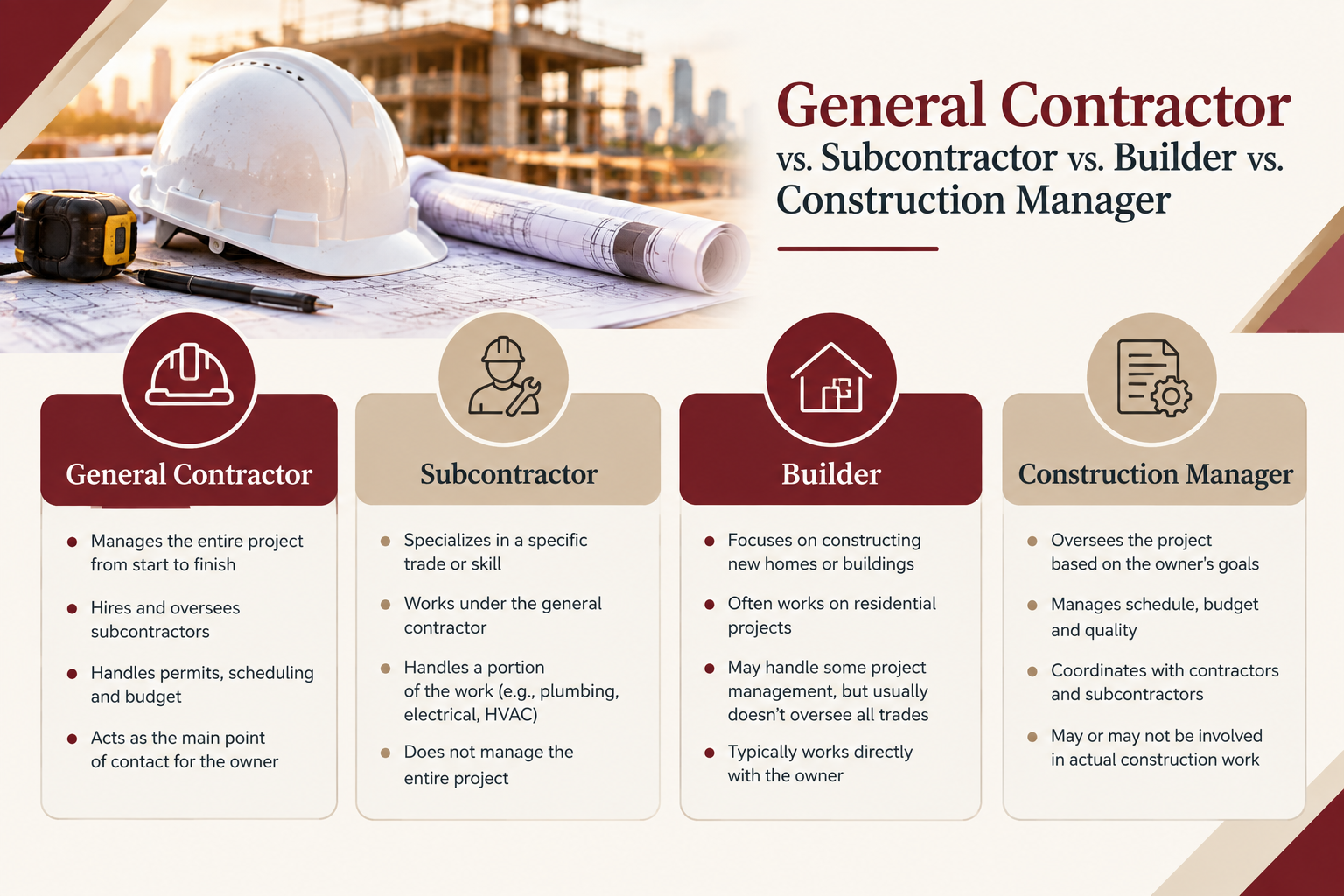
One of the most common questions in the early research stage is general contractor vs subcontractor — and how either compares to a home builder or a construction manager.
The short answer: a general contractor vs builder comparison usually comes down to overlap — a builder is often acting as a general contractor when they take on a project that involves multiple trades and supplies both labour and material.
| Role | Who They Contract With | Primary Focus |
|---|---|---|
| General Contractor | The property owner (prime contract) | Manages the whole project, including subcontractors, permits, scheduling, budget, and quality. |
| Subcontractor | The general contractor | Performs one trade scope, such as electrical, plumbing, drywall, roofing, or similar specialised work. |
| Builder / Remodeler | The property owner (often acting as GC) | Residential-focused; may self-perform some trades and manage the rest. |
| Construction Manager | The owner, for a fee (not at risk on profit) | Administers the budget, permits, and scheduling on the owner’s behalf. |
For a deeper look at how general contracting services are structured as a business model, see General Contracting. If you’re comparing specific Houston companies against each other, our General Construction Contractor page walks through what to look for.
What are the different types of general contractors?

- Commercial General Contractors
- Residential General Contractors
- Construction Management Companies
As already defined, general contracting is a business of expediting the labour, material, and equipment to build improvements to an owner’s property.
A general contractor can be generally defined as either being a self-performing contractor or a prime contractor using subcontractors.
A self-performing contractor hires employees to perform the labour, while prime contractors hire subcontractors to perform the labour and manage their contract, insurance and quality performance.
The other categorically defining factor of a general contractor is identifying their industry sector.
There are commercial general contractors and residential general contractors. Although their roles and responsibilities are similar, the types of buildings and compliance codes are significantly different.
This page covers the two categories at a high level. For a full breakdown of every category, see our dedicated guide to the Types of General Contractors.
General Contractor Commercial

Commercial general contractors provide general contracting services to owners of commercial properties such as restaurants, office buildings, warehouses, retail strip centres, and big box stores.
There are also institutional commercial contractors that build schools, manufacturing facilities, airports, bridges, and the such.
We will refer to the light commercial general contracting services for the sake of this discussion.
Commercial construction requires the knowledge and experience of more than conventional construction practices.
Commercial contracting requires the knowledge of commercial construction codes such as life safety and ADA handicap necessities.
Most commercial construction also requires fire suppression systems, including fire alarms and fire sprinklers.
Commercial general contracting services also include major civil infrastructure improvements as well, such as earthwork, drainage, retention & structures, and public parking.
To learn more about the benefits of hiring a commercial contractor, visit our Commercial General Contracting page.
Due to the general public access to commercial properties, there is a far greater need for construction document control and interaction with municipal building departments.
Commercial general contractors need to stay up to date on energy and MEP code changes that are more extensive than the residential building codes.
General Contractor Residential

General contracting in residential construction is not as clearly defined as in commercial construction.
There are many residential general contractors known by other titles, such as home builders and remodeling contractors.
When a home builder or remodeling contractor takes on a project that involves multiple trades and supplies labour and material, this is considered general contracting.
Home builders, home contractors, and remodeling contractors can work as both self-performing and prime general contractors.
In the scope of this article, we will refer to the residential general contractors as luxury builders, luxury home builders, builders, and remodelers — see our Residential General Contractors page for more on this category.
Since Marwood Construction’s business specialises as a Houston luxury home builder, we will use this service title.
So, Marwood Construction is Houston’s general contractor; we are also Houston builders and Houston luxury home builders.
As Houston builders, we are responsible to our owners for the aforementioned general contracting roles and responsibilities.
Because we are luxury home builders, we are also accountable for curated services that include designing change requests and details omitted from architectural drawings, like floor layout patterns, millwork reveals, and special locations for lighting and vents.
Because luxury home building is a one-of-a-kind custom product, luxury builders are required to meet with the owners to review almost every detail of the luxury home building.
That includes everything from the placement of the foundation on the building lot to the colour of the electrical switch covers.
Luxury home building is a highly customer-sensitive business that dictates that Houston builders spend a generous amount of time with the owners throughout the entire design and construction process.
For more details about our luxury home-building services, please follow the link to Luxury Home Builders.
General Contractor Project Management Company

The distinctive difference between a general contractor and a project management firm is in the contractual relationship between the parties.
The general contractor usually conducts business as a prime contractor with the property owner at risk to the profit that is projected.
They in turn will hire each separate trade contractor as a subcontractor to the prime contract agreement based upon a defined scope of work and exact construction budget.
In contrast, the project management company operates on a fee structure for the owner in the interest of the project.
The project management company provides administrative management responsibilities to the owner for making payments, processing progress lien releases, and insurance enforcement as the named insured.
There are several reasons that owners might select the project management company instead of the traditional general contracting company.
The first is that the project is so unique that the fixed-price bid is not appropriate for the owner to accept.
A second common reason is that the owner wants to have more control in the project performance without the construction management duties.
The project management company is also responsible for originating the required building permits, compliance progress inspections, and the final inspections and closing out the permit.
Not completing these tasks can result in many unwelcome issues in the future for the owner.
Another essential responsibility of the project management firm is the effective and efficient scheduling of the proper subcontractor in a sequential and logical progression.
Many owners do not understand the importance of an orderly and progressive nature of scheduling subcontractor performance.
There are many issues associated with the improper scheduling of progressive work.
The first is that if the work is incomplete or out of sequence, the cost of these tasks will increase due to many return trips.
In addition, not inspecting the completeness or quality of each formal work task can cause issues in workmanship to be required to be redone.
This in turn causes additional expenses for the subcontractor that must redo their work because of the previous subcontractors’ corrections.
Poorly executed schedules can also cause subcontractors frustration, resulting in subcontractors walking off jobs, major scheduling delays, and poor overall job site quality from lack of subcontractor morale.
One last major benefit worthy of noting is that a professional building contractor makes a significant contribution to the owner as a trusted adviser.
If hired for the right reasons, a building contractor will more than pay for themselves.
This is attributed to the correct and skilled implementation of the project, which guarantees the owner avoids unforeseen risks, saves time, and eliminates the need to redo a poorly done job or inefficient design.
When Do You Need a General Contractor?

- Whether the general contractor is needed or not depends on the complexity and duration of the project and how many trades are required.
- In general terms, the more trades, permits, or square footage in the project, the more efficient coordination by the general contractor would be.
- The project requires the involvement of 3 or more trades (framing, electrical, plumbing, HVAC, etc.).
- The lender or construction loan requires the presence of the licensed and insured contractor of record.
- There is a need for a single person responsible for permitting, scheduling, and quality control.
- The project requires making structural changes, extending or even constructing the entire house. or commercial remodel.
- You want protection from the compounding errors described in the risk section below.
If your scope is a single trade — say, a roof replacement or a window swap — you may only need a speciality subcontractor. Our General Contractor Remodeling Near Me page covers the remodeling-specific scope in more depth.
Benefits of a Certified Licensed General Contractor

The only real advantage of not using a general contractor is to save money on your home project investment.
So, the question you may ask yourself is, is it worth the savings to me to be my own building contractor?
To answer this question, you must understand what the building contractor actually does as well as the associated risks with these responsibilities.
Texas does not require the licensing of a general contractor.
The State of Texas does require licensing for plumbers, electricians, and mechanical contractors to provide proof of proficiency and pass an exam of minimum standards and trade building codes.
This provides a higher confidence of competency and an additional source of authority oversight.
Building contractors should continue to increase their education and stay current with new laws and required building code updates to be effective in their services.
Texas may not require licensing certification, but this would provide a method to enforce the essential business prerequisite for maintaining the highest standards in the industry.
What then are the benefits in Texas if the general contractors are not required to be licensed?
One of the most effective ways to determine a building contractor’s competency is by openly discussing their experience.
A seasoned building contractor should have a long list of completed projects to share with his qualified prospects.
These projects should reflect a similar design and quality to the home design or improvements to meet your expectations.
It is important to discuss the construction methods and practices of their past projects to determine a Houston builder’s knowledge, passion, and business acumen.
Marwood Construction’s project management team notes that Houston owners who ask to walk a completed project in person — not just view photos — get the clearest read on a contractor’s actual finish quality and attention to detail.
General Contractor Risk

There are an unlimited number of inherent systemic and non-system risks associated with the Houston general contractor business model.
A building contractor is required to either retain expert advisers or be experts in such speciality fields as finance, contract law, lien laws, and the fundamentals of all trade contracting.
Not maintaining a higher level of risk mitigation can cause the most talented construction experts to fail.
It is for this reason alone that warrants the use of a qualified building contractor instead of doing it yourself.
Another major factor is the time required to manage the many moving parts of a construction project.
As a nonprofessional, it will take you much more time than an experienced builder.
A Houston general contractor mitigates much of the construction risk through the contract process.
The construction performance standards and material specifications are carefully defined in the building plans, engineering, proposal/contract terms, and conditions.
If properly structured, these conditions can provide a specific and controlling framework for narrowing risk.
In addition, proper insurance can considerably reduce the risk of non-systemic occurrences.
One of the greatest risks of general contracting that many owners do not take into consideration when undertaking a construction project is the risk of compounding errors.
Compounding errors result from a subsequent stage of construction, resulting in quality noncompliance and the subsequent construction improvements continuing these errors.
For instance, this occurs when a foundation is formed ”out of square” or out of level and the framer follows the foundation without making the required adjustments.
By the time the home project is completed, half of the trades work is not in compliance with best practices and tolerance standards.
The substandard quality performance has been compounded by the results of the non-conforming foundation performance affecting the stage of construction improvements.
Hiring Your First General Contractor: A Quick-Start Checklist
If this is your first time hiring a general contractor, a short vetting process up front prevents most of the compounding errors and scheduling risks described above.
- Ask for a portfolio of completed projects similar in scope and quality to yours.
- Confirm general liability insurance and, where applicable, workers’ compensation coverage.
- Request references you can actually call, not just photos.
- Get the scope of work, allowances, and payment schedule in writing before signing.
- Clarify who pulls permits and who is the point of contact for inspections.
For a step-by-step local vetting guide — including where to check licences and reviews in the Houston area — see General Contracting Near Me. You can also review our list of questions to ask a general contractor before your first meeting.
General Contractor Scope of Work in Houston

A general contractor’s scope of work in Houston typically includes navigating the Houston Permitting Center’s building permit process, coordinating with licensed trade contractors for electrical, plumbing, and mechanical work, and scheduling inspections through the city’s iPermits system.
Because Houston has no traditional zoning code, a general contractor also has to track deed restrictions, floodplain requirements, and neighbourhood-specific rules that can vary block to block.
Marwood Construction provides general contracting services across Greater Houston — see our full Service Areas in Houston list, or learn more about our team on the Houston General Contractors page.
Explore More General Contracting Resources from Marwood
This page is meant to be a starting point. The links below go deeper on specific general contracting topics for Houston owners.
- What Is a General Contractor — the full definitional breakdown.
- General Contracting — how the service model works.
- General Construction Contractor — how to compare Houston companies.
- General Contracting Near Me — local vetting steps.
- Types of General Contractors — every GC category in detail.
- The General Contractor’s Role in Construction — a closer look at day-to-day duties.
- Residential General Contractors — residential-specific scope.
- Commercial General Contracting — commercial-specific scope.
- General Contractor Responsibilities — the full duties list.
- General Contractors’ License: Why Texas Doesn’t Require One — licensing background.
Looking for a Trusted General Contractor in Houston?
As Houston builders, we aspire to provide our clients with relevant knowledge and quality workmanship in a timely manner at a competitive price.
Luxury home building is a demanding and risky business for Houston builders and their owners.
Open and transparent communication is the best practice for both parties to mitigate risk and successfully negotiate and manage the complexities of commercial contracting and luxury home building.
FAQs on General Contractor
Q1. What does a general contractor do?
Ans: A general contractor oversees construction projects from start to finish, managing labour, materials, subcontractors, permits, schedules, and quality control.
Q2. What’s the difference between commercial and residential general contractors?
Ans: Commercial general contractors handle large projects like offices, restaurants, and schools, while residential general contractors focus on custom homes, remodels, and luxury residences.
Q3. Why should I hire a general contractor instead of managing a project myself?
Ans: General contractors bring expertise, risk management, vendor relationships, and scheduling efficiency—avoiding costly mistakes and delays common in DIY projects.
Q4. Are general contractors licensed in Texas?
Ans: Texas does not require general contractor licensing, but trades like plumbing, electrical, and mechanical work do require licences. Experienced contractors demonstrate credibility through past projects and expertise.
Q5. What risks does a general contractor help manage?
Ans: They help mitigate financial risks, scheduling issues, construction errors, compliance failures, and liability exposures by enforcing contracts, building codes, and insurance standards.
Q6. What’s the difference between a general contractor and a subcontractor?
Ans: A general contractor holds the prime contract with the property owner and manages the entire project, while a subcontractor is hired by the general contractor to perform one specific trade scope, such as electrical or plumbing work. See our General Contracting page for more on how this relationship is structured.
Q7. How do I go about hiring my first general contractor?
Ans: Start by reviewing a contractor’s completed portfolio, confirming their insurance, and getting scope, allowances, and payment terms in writing. Our Questions to Ask a General Contractor checklist walks through the full vetting process.